
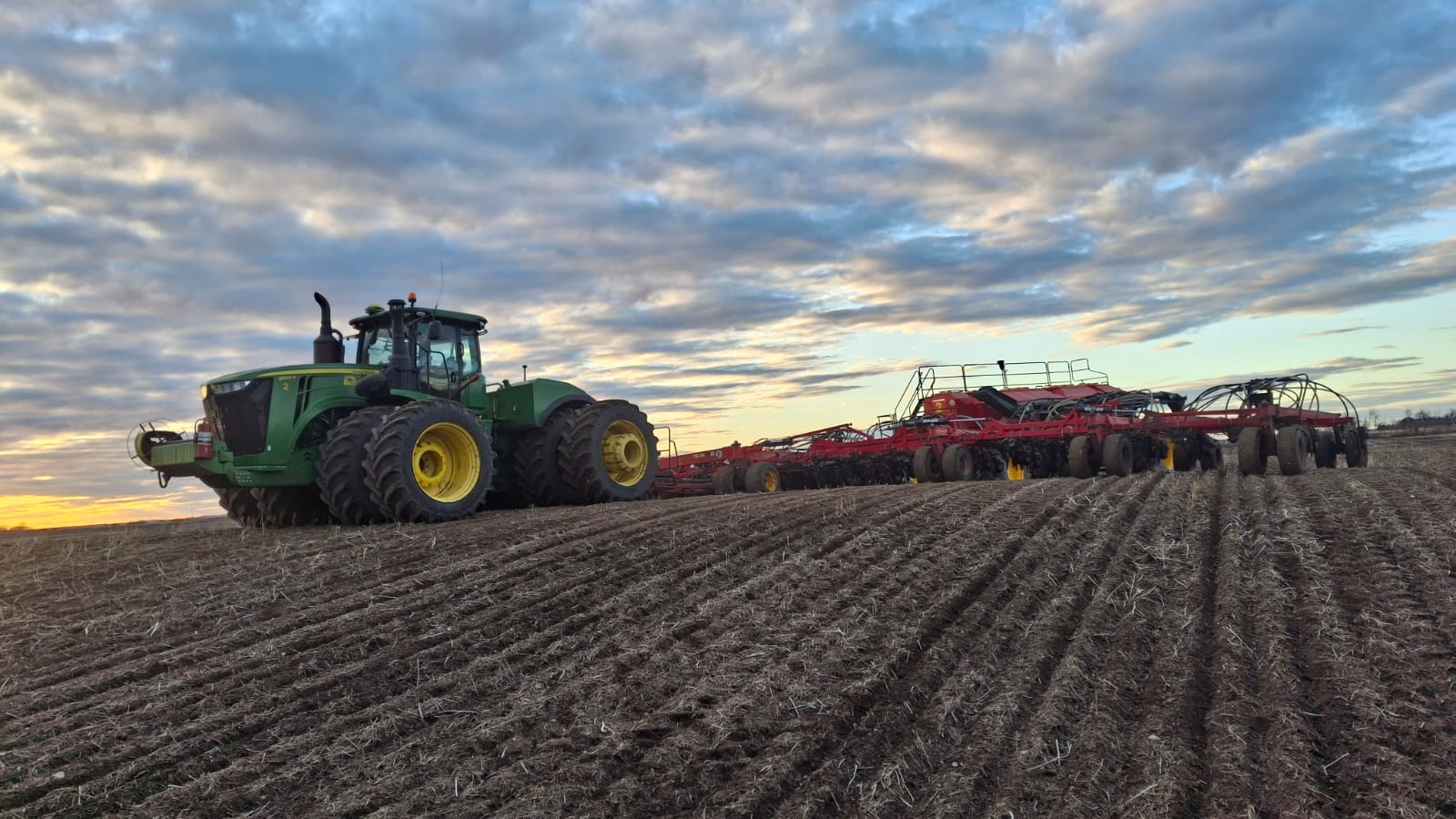
Grow Hope Saskatchewan is a project rooted in Saskatchewan’s agricultural tradition. It is quietly making a profound difference around the world. Grow Hope Saskatchewan, a faith-based initiative supported by multiple Christian faith traditions, is turning local generosity into global food security one acre at a time.
Rick Guenther, a representative with Mennonite Central Committee (MCC) Saskatchewan, says the project continues to be important to people across the province.
“It starts with the generosity of farmers who donate land, labour, and equipment to grow a crop,” Guenther explained. “Then other people, both rural and urban, join in by helping cover the input costs. Together, it raises funds for long-term food security and emergency food projects through the Canadian Foodgrains Bank and the associated agencies.”
Grow Hope Saskatchewan is a collaborative effort. Farmers commit acres of land, while supporters help fund expenses like seed, fertilizer, and fuel. The harvested crop is sold, with proceeds directed toward international food programs. Through government matching programs, those initial contributions can multiply significantly, turning a few hundred dollars into thousands in aid.
Guenther emphasized that the true impact lies in how the funds are used.
“This isn’t just about giving food, it’s about transforming communities,” he said.
The long-term food security programming funded by Grow Hope operates in more than 30 countries, with Rwanda serving as one major example. There, the work goes far beyond simple aid, focusing instead on equipping farmers with the tools and knowledge to sustain themselves.
The program is built around six pillars, each designed to strengthen food security at multiple levels.
The first is agronomic education. Farmers participate in field schools where they learn conservation agriculture techniques such as minimal soil disturbance, crop diversification, and composting. These practices not only improve yields but also protect the land for future generations.
The second element involves the distribution of livestock. Animals such as goats or cattle provide both income opportunities and organic fertilizer, creating a more sustainable farming system.
Third, participants are encouraged to develop kitchen gardens while receiving nutrition training. This ensures families are not only producing more food, but also healthier, more balanced diets.
The fourth component is financial empowerment and it addresses one of the biggest challenges many farmers face: access to capital. In the absence of access to traditional financial institutions, communities form Village Savings and Loan Associations (VCLAs), pooling resources to create their own lending systems.
“They’re essentially building their own version of credit unions,” Guenther noted. “It’s very similar to how some financial systems began here in Saskatchewan decades ago.”
Conflict mediation training forms the fifth pillar of the program. Recognizing that cooperation can sometimes lead to disagreements, participants are equipped with the skills to resolve disputes and maintain strong community relationships.
The sixth pillar revolves around collective storage and marketing systems that allow farmers to better manage and sell their crops, increasing both efficiency and profitability.
The results have been impressive. According to Guenther, one partner organization in Rwanda, the Peace and Sustainable Development Network, has recorded crop yield increases of 30 to 50 percent among participating farmers since 2014.
In some cases, the improvements are even more dramatic. Guenther pointed to cassava, a staple crop in Rwanda, where traditional methods might produce roots weighing around 26 pounds. With conservation agriculture techniques, yields have reached up to 110 pounds per plant which is more than a 300 percent increase.
“That kind of change is life-altering,” he said.
The program’s reach continues to expand. Through this partner alone, more than 30,000 farmers in Rwanda have received training, nearly 1700 savings groups have been established, and 98 percent of participants now maintain kitchen gardens. The success has even drawn the attention of the Rwandan government, which is working to incorporate conservation agriculture into its national food security strategy.
With nearly 15 million mouths to feed in a country that is about 4% the size of Saskatchewan, that kind of success makes a big difference.
Guenther had the opportunity to witness the impact firsthand during a visit to Rwanda in February 2025.
“We were welcomed with open arms,” he recalled. “People were incredibly grateful. It was humbling to see the difference this makes in their lives.”
Back home in Saskatchewan, the program is notable not only for its global reach but also for its ability to bring people together locally.
“There can be divisions between rural and urban communities,” Guenther said. The goal of this project is something everyone can agree on. People need to be fed. It’s a project that unites us.”
The initiative is also uniquely collaborative from a faith perspective. Since its beginnings in 2018 as a partnership between MCC Saskatchewan and the Saskatoon Catholic Diocese, Grow Hope has expanded to include six Christian faith traditions, including Baptist, Anglican, Presbyterian, and Lutheran organizations.
For those looking to get involved, participation is open to everyone. Farmers can contribute land and resources, while others can support by sponsoring input costs.
“Every contribution matters,” Guenther said. “No matter the size, it all adds up and through the multiplier effect, and can make a tremendous impact.”
Guenther explained the multiplier effect. “It costs up to $350 an acre to provide the input costs to farmers to grow a crop, but any donation contributes to that. When people donate to put the input crops in the ground, that results in a crop. That turns a $350 donation into as $600 or more by the time the crop is sold and donated to the Canadian Foodgrains Bank. And then it is often matched by the Canadian government up to a 4:1 ratio, turning a $350 donation into as much as $3000 to provide food to people across the. world.
Whether it’s a field of canola in Saskatchewan or a cassava plot in Rwanda, Grow Hope Saskatchewan is proving that agriculture can be a powerful force for good, bridging continents, strengthening communities, and offering hope where it’s needed most.
https://www.youtube.com/watch?v=wMCB6qOHCvY.
https://www.growhopesk.ca/donate